
SIGNAL QUALITY
Image sourced from Wikimedia Commons
Some time in 2020 (summer, possibly later), I was on a phone call with one of my best friends - someone I grew up with from about the ninth grade on. Someone I spent a lot of time with, from ages 15 - 30. For some period of time, this is someone for whom I could finish his sentences, and he mine.
On this phone call, my friend explained to me how he quickly recovered from COVID thanks to taking Ivermectin. This surprised me. Everything I had been reading/hearing about Ivermectin as a treatment for COVID suggested that it was not effective at all.
Ever since that conversation, I’ve been pondering how it could be that someone with whom I had been so close for so long could come to such a different conclusion about an important matter.
In today’s information environment, we have many challenges. The speed and ease with which information travels is one. High-quality and low-quality information moves equally well around the globe in the blink of an eye. The advertising-based revenue model of most media outlets creates a basic alignment problem, where they are incentivized to cover news and write stories that are more likely to spur engagement (which rhymes with enragement), leaving many wonky or less engaging, detail-rich stories unseen or unnoticed. And as individuals we all have cognitive biases - Tim Urban’s deep dive into how tribal, sports fan-type thinking has driven a lot of politics in the last decade or so is highly informative on this front.
Setting all of this aside, the question I want to examine is this: How does a person seeking objective truth in today’s world assign a quality score to information? Going back to that conversation with my friend, he clearly was assigning different scores than I was to the various information available to us at the time.
I’m not suggesting that we should always land on the same answers to important questions. But understanding why we believe what we believe is important, as it is the only way we might improve on how we collect and process information in the future.
Since we can’t personally witness every consequential event that happens in the world each and every day - we must have trusted proxies. So, how does one sort out higher quality information sources from amongst all of the options?
In attempting to wrap my brain around this challenge, I reached out to someone I follow on Twitter - Jay Rosen, professor of journalism at New York University. Jay’s critiques of news outlets’ coverage of politics in recent years has been revelatory. I wondered if he knew of any tools to help consumers of media to assign “quality scores” to news outlets or reporters. He kindly made me aware of a service called NewsGuard.
NewsGuard is a service that assigns “trust scores” to more than 8,500 news and information websites. Subscribers to this service download an internet browser plug-in that makes the scores available as they browse the web in real-time. This service was created by a team of journalists, who continuously assess the credibility and transparency of news and information websites based on the following nine criteria:
1. Does not repeatedly publish false content.
Factual errors are generally minor.
Major mistakes are quickly and transparently corrected.
The site doesn’t quote other news sources that frequently make false claims.
2. Gathers fair and accurate information responsibly.
They reference multiple sources.
Sources present direct firsthand information on subjects or events.
They do not egregiously distort or misrepresent information.
3. Regularly corrects and clarifies errors.
Effective practices for identifying errors.
Transparent acknowledgement of errors when they occur.
Does not leave significant false content uncorrected.
4. Handles the difference between news and opinion responsibly.
Clearly distinguish News reporting from Opinion writing.
When reporting news, does not “cherry pick” facts to advance opinions.
Content providers who advance a particular point of view disclose that point of view.
5. Avoids deceptive headlines.
No false info in headlines.
No significant sensationalization, otherwise not reflective of the underlying story.
6. Discloses ownership and financing.
User-friendly disclosure of ownership and/or financing of the website/new outlet.
Notable political affiliations made clear.
Readers know who is funding the content and any relevant interests the owner or funder might have in the content.
7. Clearly labels advertising.
The site makes clear which content is paid for and which is not.
8. Reveals who is in charge, including potential conflicts of interest.
Those in charge of the content are identified on the site.
There is a way for readers to contact the site about editorial issues.
9. Provides names of reporters/content creators, along with either contact or biographical information.
Information about who is producing content for the site is made accessible to readers in a clear fashion.
The sites evaluated by NewsGuard are assigned a score ranging from 0 - 100, resulting in the following credibility tiers:
100 High Credibility
75-99 Generally Credible
60-74 Credible With Exceptions
40-59 Proceed With Caution
0-39 Proceed With Maximum Caution
As someone looking for something close to objectivity, these criteria seem reasonable to me.
Just as we must trust reporters to act as our proxies when reporting on the events of the day, so too must we trust the people at NewsGuard to fairly use these criteria when evaluating news sources, if we are to use their ratings when consuming news online.
NewsGuard is led by two veteran journalists and entrepreneurs: Steven Brill founded The American Lawyer, Court TV, and the Yale Journalism Initiative. Gordon Crovitz was publisher of The Wall Street Journal and a columnist for the paper.
Curious to see how my default news sites fared against these criteria, I subscribed to NewsGuard so that I could view the ratings. My primary news sources: The Wall Street Journal, Washington Post, New York Times, NPR, PBS, and the BBC - all score very high (most receive 100s). Sources like FOX News and OAN fall well short of these scores. (FYI - I am not sharing specific sites’ scores because the NewsGuard user agreement prohibits this.)
It’s important to acknowledge that this scoring system is not perfect, nor is NewsGuards implementation of it. In fact, nothing is perfect - reporters sometimes make mistakes, warranting retractions. I’m mindful to not let the notion of perfect be the enemy of good.
After the 2020 Presidential election, numerous news sources gave credence to unfounded theories of election fraud. Even if they didn’t outright report that such fraud had in fact occurred, the amount of airtime that they gave to proponents of these baseless claims created (at a minimum) a sense for many Americans that “If there’s smoke there must be fire.” Some people were so alarmed and outraged that they stormed the U.S. Capitol on January 6, 2021. This behavior was not unreasonable for those who trusted that a major fraud had actually occurred. Similarly, if doctors say that Ivermectin is a valid, effective way to treat COVID-19, some people will certainly rely on that guidance when making their own personal health care decisions.
We live in an age where virtually everyone has a high-quality camera and microphone, and are able to produce competent looking videos of all types. We are flooded with “content,” and if I look hard enough I can find someone saying just about anything. Even though such content has the look and feel of something that is trustworthy, it is apparent to me that a great deal of it is factually or contextually false. Whether due to a lack of reporting rigor, a lack of understanding, or simply a function of bad-faith actors pumping out falsehoods, when it comes to information our mindset should be one of Buyer Beware.
It’s a damn wonder that humanity keeps moving forward. Despite everything - biased reporting, misaligned incentives, individual cognitive biases, somehow we tend to get a little better every day. On a macro level, humanity is getting collectively smarter, it seems to me.
Paying $5/month to subscribe to NewsGuard will not ensure that you receive perfect information. But it might remind you to be aware of your news sourcing, and mindful that all sources of information have flaws. Even without subscribing, we can all benefit from considering NewsGuard’s nine apolitical criteria for evaluating information sources.
The world has always been chaotic. Perhaps slightly less so today, in some key ways. But when it comes to sourcing and processing information, it feels like the Wild West to me. It’s not rocket science - it’s much harder than that. Rocket science relies exclusively on proven principles of physics. We have to navigate our lives using information that contains so many flaws, both in it’s provenance and also in how we process it using our fallible critical thinking skills.
As adults, we have to own our experiences and our decisions. The people who have been arrested and charged with crimes related to the January 6th storming of the U.S. Capitol are facing real consequences, and the fact that they were relying on bad information has not been much help to their defense.
We can’t fix all the many flaws in the information environment, but we can improve how we evaluate the information to which we expose ourselves.

It’s Sprrringtime!
A story I recall every year around this time.
Greetings!
I hope you are well. Yesterday's weather was glorious. Today and tomorrow will be rainy, with a nice stretch of warm and sunny weather coming in behind the rain.
I've been too busy recently to call a friend of mine. I have a story to share that involves him and his family. Since I didn't have to time to get his permission to share personal details, I have stripped out such details. A good story still remains.
My friend once shared this story about his mother. It is set in the May/June timeframe, and I think of it every year around this time. My friend had a running buddy - every Saturday morning they would go for long runs. On the Saturday of this story, these two guys had agreed to stop at a third friend’s house, this third friend wanted to join them on this run.
As happens on most Saturday mornings, the run culminated at my friend’s house out in the country. It was (and still is) their custom to fix a big breakfast on such Saturdays. One of the people cooking breakfast on the morning of this story was my friend's mother. She was a wonderful older woman who had emigrated to America when she was young, and still retained a little bit of her accent when she spoke. So my friend and his buddy and the third friend that they picked up along their route all walk into this farmhouse kitchen, glistening with sweat.
The third friend was relatively new to town, and this was her first visit to the house. Because it was a warm Spring morning, this young woman was wearing an athletic top, with a bare midriff. Perfectly appropriate for this day and age, but perhaps a bit immodest for the era of my friend's mother. My friend could see that his mother was surprised, and a little bit confused when they walked in the door. He was curious to see how she would respond to this unexpected visitor.
His mother simply said this, with her soft accent: “It’s SPRRRINGtime!!” I think of her and this story every Spring. She might have said many things, but she chose to be welcoming. She chose to celebrate that beautiful, sunny moment. I was not there to actually witness this event, but I can imagine exactly how it played out and it makes me smile.
UPDATE: I've been hinting at this for a while. I launched a new website this past week - it will be a place where I share some of my kitchen adventures, photos, and post longer-form essays on a wide range of topics. The web address should be easy to remember - it's just www.nealbell.com. I will also be mirroring my weekly Maamos Kitchen newsletter posts on the Blog at this site, so it can function as a turnkey way to keep up with my mental meanderings. There is a little email list signup bar in the footer of each page - please opt into that email list, if you would be so kind. My first longer form essay drops in the new blog this morning - it's called Signal Quality, and it examines he we choose to trust different information sources in our lives. I hope you check it out.
Sunday Supper
I've been running around this weekend, so will keep it simple for Sunday Supper. These Chili Crisp Salmon Bowls, w/ Avocado Mango Salsa from Half-Baked Harvest hit a lot of fun notes - bold spice, creamy avocado, and the sweetness of fresh mango. You can easily substitute shrimp or chicken in for the salmon if you'd prefer a different protein.
Sunday Music
After a humbling (but beautiful) day on the golf course in Toledo yesterday, I randomly recalled the many fun times we enjoyed in the car with our children, back in their childhood days. There was a stretch of time where we drove them to my parents' home in Pickerington for babysitting on a regular basis. Those car rides were made immensely fun by this series of children's albums that cover the ABCs, 123s and fundamental concepts of Science with really fun, catchy songwriting. Listening to these tunes brought a smile to my face last night. And here's a link to a NPR Tiny Desk concert that this two-man band performed about eleven years ago. What a distinctive duo. I love their creativity.
Have a great week ahead! Offer support to others. Make good use of this day. And let me know how I can help.
Peace & Love,

BLUE PLATELET SPECIAL
Blood donation is often overlooked. Individual donations have a great impact.
Greetings!
I hope you had a great week, and are enjoying the weekend. Thus far, the Spring showers have been manageable. We have some more rain through Tuesday, followed by moderate temps and clear skies. Everything is so lush and green.
I donated platelets for the first time this past Thursday. A couple of weeks ago, the Red Cross called asking me to consider it, and I said yes. I’ve been a regular blood donor for many years, hiking up the hill to donate on Denison’s campus most of the time. The platelet donation experience was more involved.
Firstly, I had to drive to Gahanna to donate. Perhaps there are closer locations, but I went to Gahanna. The procedure takes two hours, but in total I spent three hours at the donation site in Gahanna, which included the time require to check in, have my vitals taken, wait briefly for a donation bed to be ready, and wait a few minutes after the donation to ensure I was feeling capable of driving home. Including the time it took to drive to/from the donation center, this was a four hour commitment, all-in.
To the naked eye, the most obvious difference between donating platelets and a regular blood donation is the fact that they insert needles into both arms. Blood is drawn out one, and flows into an apheresis machine, which spins the blood, separating it into various components (plasma, platelets, white blood cells and red blood cells). The machine siphons off the platelets, then returns everything else to the donor via the second needle in their other arm.
The time commitment is probably the biggest difference when comparing platelet donation versus a basic blood donation. One does have to sit still for two hours. Fortunately they have TVs with Netflix, plus wireless headphones. I queued up a movie and was able to enjoy myself while the blood separator machine worked its magic. There is a small amount of anticoagulant fluid that donors receive when the machines return the non-platelet blood units. This fluid sometimes causes a tingling sensation - I experienced this, but it was very mild. I’ve since learned that taking a Tums in advance helps minimize this effect (the calcium in Tums what does this trick).
Platelets are often used to assist cancer patients. Given that I lost both of my parents to cancer, it makes me feel good to think that my donation may be helping someone who is battling the disease. Donating blood is such a simple gesture. Nothing sexy about it - just straightforward, sit down and let the nurses do their thing. Getting into a regular cadence of donation really adds up over the years. Please consider donating if you are healthy and able. It's an easy thing to not do. Nobody will notice your absence from the blood drive. But in my experience, choosing to do it is truly gratifying.
Sunday Supper
This week’s Sunday Supper suggestions all come from Serious Eats, a site that I truly love and respect. Their recipes often require a little more time and effort, but always deliver great outcomes. Here are four great Spring ideas, all of which could work together if you want to make a big multi-course Sunday meal. Let’s start with a cocktail - this Mezcal Negroni w/ Grapefruit looks delicious. For first course, this Spring Vegetable and Arugula Salad w/ Labne looks wonderful. For pasta course this Creamy Orecchiette w/ Spring Onions, Fennel and Bacon would be amazing. Lastly, this Peruvian-style Grilled Chicken w/ Green Sauce is a wonderful protein option. Mix or match them as you see fit. You can’t go wrong.
Sunday Music
The Spring rains remind me of the wonderful tune from Antonio Carlos Jobim, Aguas de Marco (Waters of March). “Of the waters of March / It’s the promise of life / In your heart, in your heart”. This duet by Andrea and Angel is a wonderful rendition. Jobim’s Desafinado was the composer’s beautiful response to his critics, who did not initially appreciated his harmonic ideas. The lyric “Those who sing out of tune also have a heart” really resonates with me. This performance of the song by Paola Hermosin has English subtitles which which is helpful in appreciating Jobim’s beautiful lyrics. If you not seen this before, this performance of Jobim’s One Note Samba by Dean Martin and Caterina Valente is so fun. Lastly, I share this performance by Pat Metheny of Jobim’s Insensatez (How Insensitive), a rendition which honors Jobim while letting Metheny’s unique sound shine through. Enjoy!
Have a great week ahead! Offer support to others. Make good use of this day. And let me know how I can help.

Big Cities
New York & Washington DC did not disappoint last week.
Spring really sprang this past week, didn’t it? I spent six of the past eight days out of town, fortunately the weather was great in New York City and Washington DC as well.
We had the good fortune of reuniting with our former foreign exchange student in New York last weekend. It was so, SO good to see her. We dined at amazing restaurants, toured the Union Square Green Market, the Chelsea Flea market, walked the High Line, and had many laughs taking in the standup comedy at The Village Underground. We flew over early Saturday, returning by dinner time Sunday. The extra special surprise of the visit was just how good the pizza was at John’s of Bleeker Street, a pizzeria recommended by Tim Degenero of 7/10 Bakery (when your favorite baker suggests a pizza shop, you should really take note). Thin, sturdy crust fired in a charcoal oven, topped with the most balanced tomato sauce I can ever recall. A must-visit if you find yourself in Greenwich Village.
On Monday I drove to our nation’s capital, arriving just in time for dinner at Jose Andre’s Zatinya, followed by a night of Washington Capitals hockey (they hung three goals on the New York Islanders in the first period, controlling the game from beginning to end). After our meetings on Tuesday, we were able to get out and walk around the National Mall and Tidal Basin, taking in the many wonderful monuments. And on Wednesday we dined at Thatcher & Rye in Frederick, Maryland (it was great). Before hitting the road for home on Thursday, our host took us to Glenstone, a museum in Potomac, Maryland that was really super nice. It has a series of buildings laid out across a large property, with art installed in each building, and also outside, to take in as you walk from building to building. I highly recommend a visit - tickets are free, but must be reserved in advance to ensure you can tour the grounds on your preferred schedule (they manage the number of people who enter, to ensure a quality experience for all visitors).
It was a great, somewhat intense week of travel. I got home just in time to have a nasty head cold bloom in my sinuses. A fine trade, given how great the week otherwise was. Hopefully I’ll shake this cold by Monday and hit the ground running. There’s always so much to do.
Sunday Supper
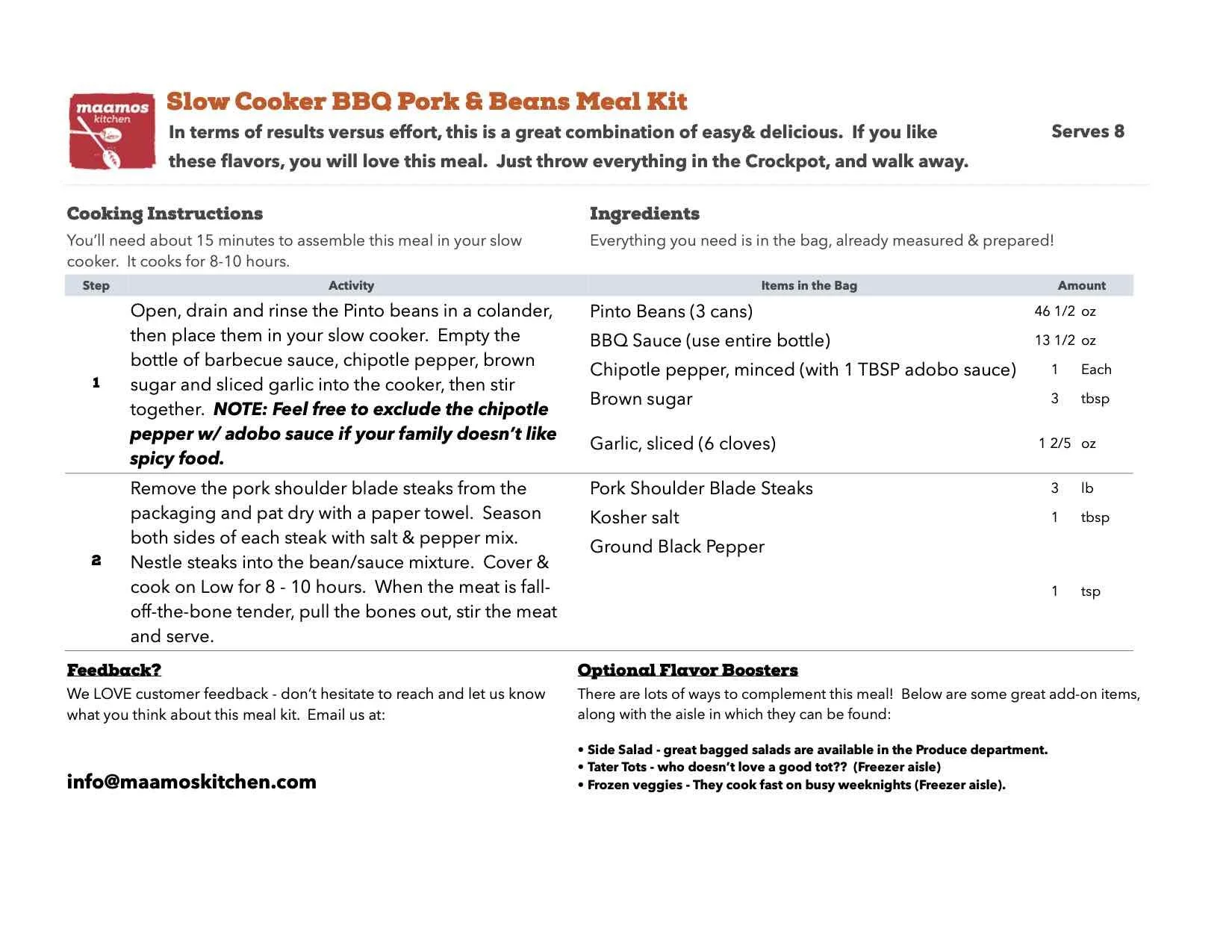
This Slow Cooker BBQ Pork & Beans is a great thing to get cooking early today so that you can get some yard work done between the rain drops this Sunday:
Sunday Music
Before I share some music with you, I must share this video of comedian Chris Turner. We saw him perform in New York City last weekend. His closing bit was to freestyle rap about topics randomly suggested by the audience, and it was truly amazing.
Also, I watched this documentary of Jason Isbell Friday night. If you have HBOMax, I highly recommend it.
Finally, I share this concert performance by RAYE, a singer from England rising in popularity. Enjoy!
Have a great week ahead! Offer support to others. Make good use of this day. And let me know how I can help.